Microdosing GLP-1: What the Trend Gets Right and Where It Falls Apart
Very low doses of semaglutide and tirzepatide are being marketed for appetite control, longevity and side-effect avoidance. Some of the logic is sound. The way it is being sold in India is not.
ALTRcare Medical Team
Clinical Editorial
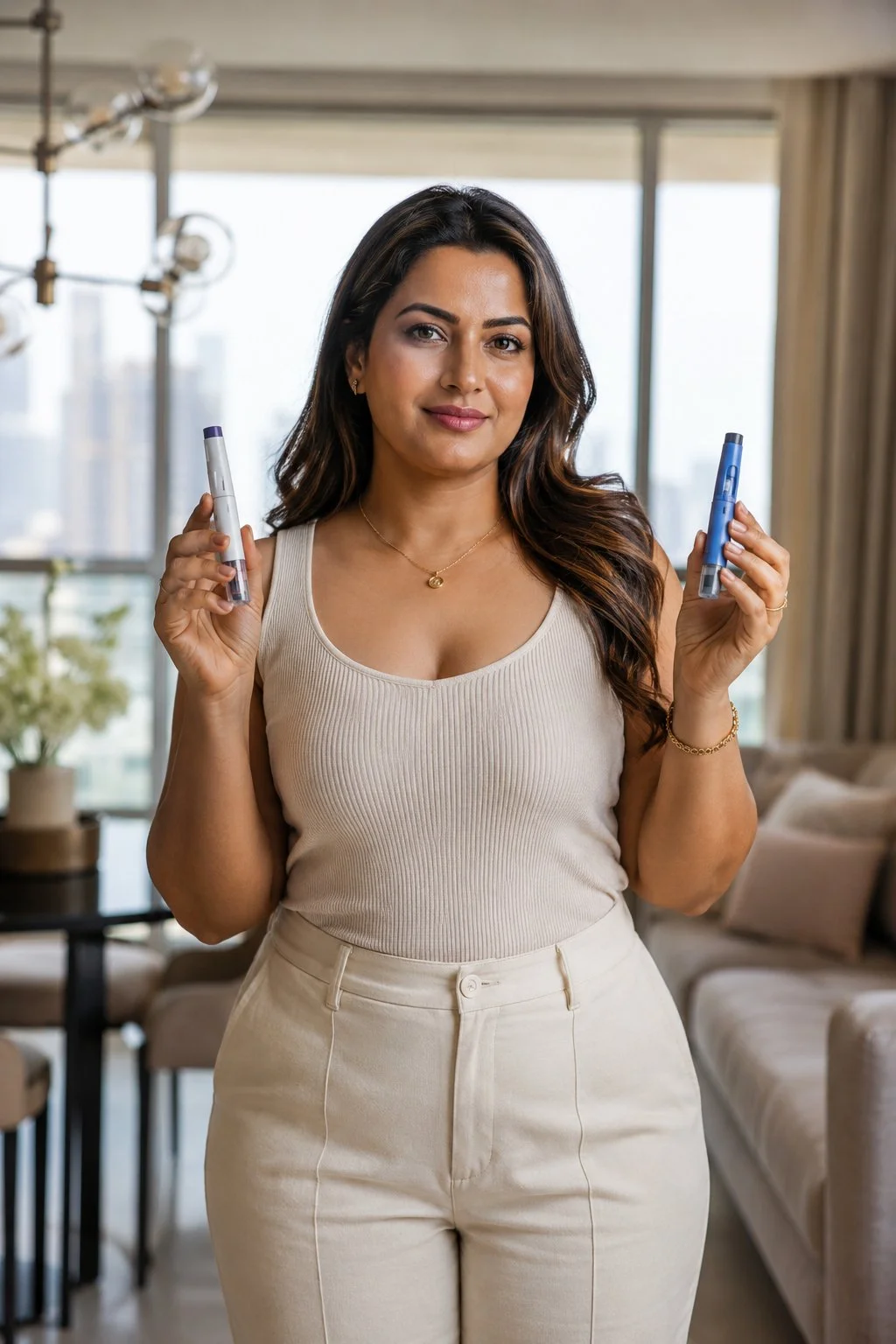
The short answer: microdosing means deliberately staying at a very low GLP-1 dose, well below the doses tested in the weight-loss trials, usually for appetite control with minimal side effects. The core idea, that the lowest effective dose is the right dose, is genuinely good clinical practice. The version being sold online, involving unlabelled vials, self-measured units and longevity claims, is a different thing wearing the same word.
Where the idea came from
Every GLP-1 already starts at a low dose. Semaglutide begins at 0.25 mg weekly, a dose designed mainly to let your stomach adapt. Patients noticed that appetite drops considerably even at these starting doses, and asked the obvious question: if this is working, why keep going up? Microdosing is that question turned into a marketing category.
What is actually true
- Response varies a lot between people. Some patients get strong appetite suppression at 0.5 mg and genuinely do not need 2.4 mg.
- Side effects are dose-related. Staying lower usually means less nausea, less reflux and better adherence.
- Staying on a tolerable dose beats quitting a higher one. A dose you can hold for a year does more than a dose you abandon in month two.
- Titration is not a race. Good doctors already hold patients at a lower step when it is working, which is what a maintenance dose is.
This is just individualised dosing
When a doctor keeps you at 1 mg because you are losing steadily and feeling well, that is not microdosing, that is treatment. The word only becomes a problem when it is used to sell a protocol that skips the doctor.
Where it falls apart
The trials that produced the weight-loss numbers everyone quotes used specific target doses. When you deliberately sit far below them, you are in territory without trial data, so nobody can tell you what average result to expect. That is not automatically wrong, but it should be said out loud instead of hidden behind confident numbers borrowed from studies that tested something else.
The bigger problem in India is practical. Microdosing is usually paired with buying research vials or compounded preparations and drawing doses yourself with an insulin syringe. That introduces several failure points at once.
| What is being done | What can go wrong |
|---|---|
| Buying unlabelled or research-grade vials | No guarantee of contents, concentration or sterility |
| Measuring your own units from a vial | A tenfold dosing error is easy and has happened |
| Reconstituting powder at home | Contamination risk and unknown final concentration |
| No prescriber involved | No screening for thyroid cancer history, pancreatitis or pregnancy |
| Longevity or anti-inflammatory claims | Not what these medicines are approved for, and not established at these doses |
The dosing error is the real danger
Doses in these medicines are milligrams; insulin syringes are marked in units. Confusing the two has caused serious overdoses internationally. If you are not a clinician, this is not a calculation to do at your kitchen table.
The sensible version
If your interest in microdosing is really an interest in taking as little medicine as possible, say that to your doctor. It is a completely reasonable goal and easy to build into a plan: titrate slowly, stop increasing when appetite is controlled and weight is moving, and hold there. You get the benefit the trend is promising, from a licensed pen with a known dose, with someone watching your labs.
Care that answers questions like this
ALTRcare patients get a doctor-led plan, monthly follow-ups and same-day WhatsApp answers, not just a prescription. Take the free 2-minute assessment to see if a GLP-1 plan fits you.
Key takeaways
- Microdosing repackages a real principle: the lowest dose that works for you is the right dose.
- Doses far below trial levels have no trial data attached, so expected results are unknown.
- Most of the harm comes from self-dosing vials, not from the low dose itself.
- Milligram versus insulin-unit confusion is a documented cause of serious overdose.
- Ask your doctor to hold you at your lowest effective dose instead of buying a protocol online.
Frequently asked questions
Does microdosing semaglutide work for weight loss?
Lower doses do suppress appetite and some patients respond well at 0.25 to 0.5 mg. What is unknown is the average result at doses deliberately kept below those tested in trials, because that is not what the studies measured.
Is it safer because the dose is smaller?
The dose itself is usually better tolerated, but most of the real risk in microdosing comes from unregulated vials and self-measured dosing, not from the amount of drug.
Can I ask my doctor to keep me on a low dose?
Yes, and it is a normal request. If your appetite is controlled and weight is moving steadily, holding at a lower dose is standard practice.
What about microdosing for longevity or inflammation?
These are active research questions, not established uses. Prescribing decisions in India today should be based on approved indications, not on early signals.
Are the vials sold online the same medicine?
There is no way to verify the contents, concentration or sterility of an unlabelled vial. That is exactly why a licensed pen with a fixed dose dial is the safer route.
Ready to take the next step?
Take the free 2-minute eligibility assessment. A doctor reviews it before anything is prescribed, with no obligation.
This article is for general educational purposes and is not a substitute for personalised medical advice. GLP-1 medications are prescription-only and not suitable for everyone. Always consult a qualified doctor before starting, changing, or stopping any treatment.