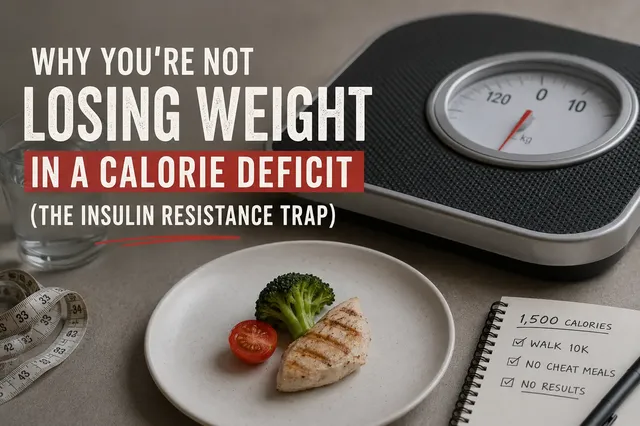
Why GM, Keto and Crash Diets Fail Indians After Month Three
Almost every restrictive diet works for six to ten weeks. What happens after that is biology, not weakness, and understanding it changes what you try next.
ALTRcare Medical Team
Clinical Editorial

The short answer: crash diets fail at around month three because three things arrive together. Your body starts burning slightly fewer calories than expected for its new size, hunger hormones rise above where they were before you started, and the social cost of eating differently from everyone around you finally exceeds your motivation. None of that is a character flaw. It is a predictable pattern, and once you can see it coming, you can plan for it.
What happens in the first six weeks
Every restrictive diet, whether it is GM, keto, a 1200-calorie plan or 16:8 fasting, works the same way at the start. You remove a large category of food, you eat less without counting, and a chunk of the early loss is water attached to stored carbohydrate. The scale drops fast, which feels like proof the diet is special. It is mostly proof that you ate less.
What changes by month three
- 1Metabolic adaptation. A smaller body burns fewer calories. On top of that, energy expenditure drops slightly more than size alone predicts, and unconscious movement falls: you fidget less, walk less, take the lift more. The gap between what you burn and what you assume you burn widens quietly.
- 2Hunger hormones push back. Ghrelin, the hormone that drives appetite, rises during weight loss and stays elevated. Leptin, which signals fullness, falls. Studies following people after diet-induced weight loss have shown these changes persisting a year later. Your hunger at month three is genuinely stronger than it was at month zero.
- 3The social bill comes due. Six weeks of declining sweets at the office and eating separately at family dinners is manageable. Six months is not, especially through a wedding season or festival calendar. Indian eating is communal, and diets that require you to opt out of that are borrowing against a limited resource.
- 4The rules get impossible to follow. Any plan that bans rice, roti, dal or fruit is running against the food most of the country actually eats. Sustainability is not a virtue you bring to a diet. It is a property the diet either has or does not.
The regain is not proof you failed
Most weight lost through restriction alone is regained within a few years, across the research literature and across ordinary experience. If that has happened to you two or three times, you have replicated a well-documented result, not demonstrated a personal weakness.
What each popular plan gets right and wrong
| Approach | What it gets right | Where it breaks |
|---|---|---|
| GM diet | Rapid initial drop, simple rules | Mostly water and muscle, unsustainable past a week |
| Keto | Genuinely reduces appetite for many | Hard against Indian staples; regain common on reintroduction |
| Intermittent fasting | Simplifies decisions, no food is banned | Works only if the eating window does not become a binge window |
| Very low calorie plans | Fast results, useful pre-surgery under supervision | Muscle loss and strong hunger rebound without supervision |
| Detox and juice cleanses | Nothing of substance | No mechanism; the liver already does this |
What actually survives month three
- Protein at every meal. The most reliable appetite lever available without medication, and the one that protects muscle while you lose fat.
- Resistance training twice a week. Keeps the muscle that keeps your metabolic rate up. Walking is good for you but does not do this job.
- A plan that includes rice and roti. Portion them, do not ban them. Banned foods return with interest.
- A festival and wedding strategy decided in advance, not improvised at the buffet.
- Tracking something other than weight. Waist measurement, energy, how clothes fit, blood markers. Weight alone is too noisy to steer by.
When biology needs medical help
If you have insulin resistance, PCOS, hypothyroidism or a BMI in the range where obesity is a diagnosed condition, the hormonal pushback is stronger and the diet-only success rate is lower. That is the situation medication was developed for: not as a replacement for eating well, but as a way to bring appetite signalling back to a level where eating well is actually possible. Discussing that with a doctor is a reasonable next step after the third failed attempt, not an admission of defeat.
Not sure where you stand?
ALTRcare's free 2-minute assessment gives you a doctor-reviewed read on your BMI, waist and metabolic risk, with no obligation to start anything.
Key takeaways
- Rapid early loss on any restrictive plan is largely water and reduced intake, not a special mechanism.
- By month three, metabolic adaptation and elevated hunger hormones are both working against you.
- Indian social eating makes opt-out diets expensive to maintain past a couple of months.
- Protein, resistance training and portioned staples survive where bans do not.
- Repeated regain is a documented pattern, not a personal failure. It is a reason to change approach.
Frequently asked questions
Why do I lose weight fast then stop?
Early loss includes water released alongside stored carbohydrate, which happens quickly and only once. After that, you are losing actual fat, which is slower, while your body is also burning slightly less than before.
Is keto bad for Indians?
Not inherently, and some people do well on it. The practical problem is that it removes rice, roti, most dal preparations and fruit, which makes it hard to sustain within Indian family eating and hard to return from without regain.
How much weight loss per month is realistic?
A steady, sustainable rate is usually modest and gets slower over time. Ask your doctor for a target that suits your starting weight, because a rate that is safe for one person is too aggressive for another.
Does metabolism get permanently damaged by dieting?
Permanent damage is the wrong framing, but reduced energy expenditure and elevated hunger signalling after weight loss are real and can persist. Preserving muscle through protein and resistance training limits the effect.
Should I try one more diet or see a doctor?
If you have lost and regained the same weight more than twice, or you have PCOS, thyroid disease or insulin resistance, a medical review is more useful than another plan. There may be a treatable reason the plans keep failing.
Ready to take the next step?
Take the free 2-minute eligibility assessment. A doctor reviews it before anything is prescribed, with no obligation.
This article is for general educational purposes and is not a substitute for personalised medical advice. GLP-1 medications are prescription-only and not suitable for everyone. Always consult a qualified doctor before starting, changing, or stopping any treatment.